Marketing
AI
Brand Strategy
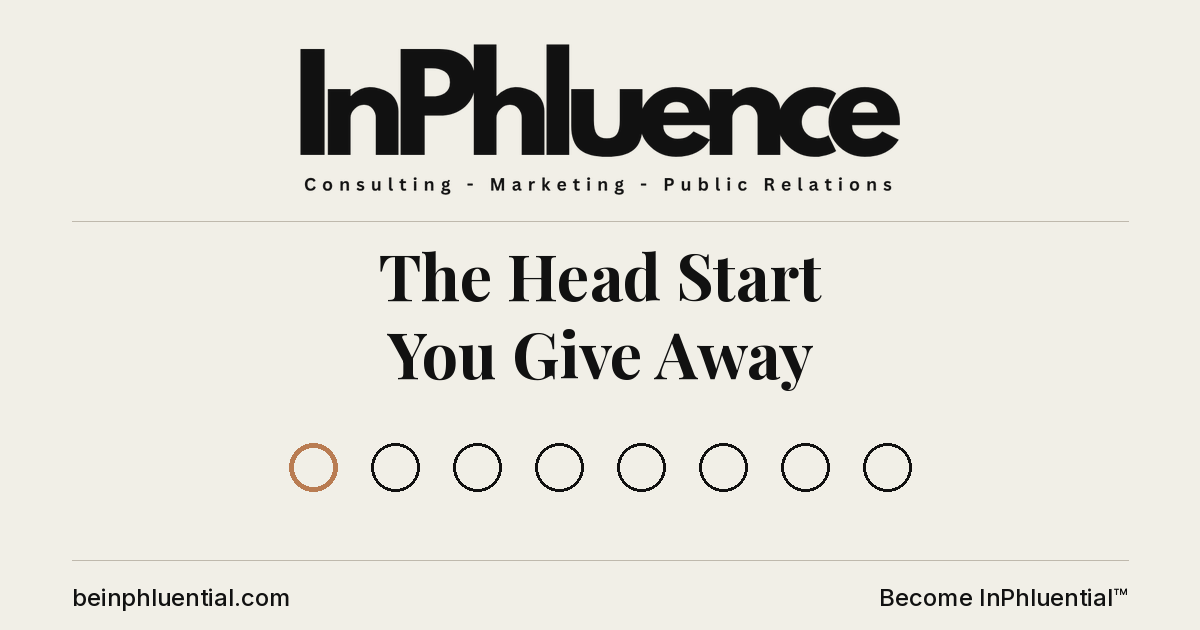

Every customer you start at zero is a completion you are quietly paying to lose. This is what withholding a head start costs.
In 2006, two marketing researchers, Joseph Nunes (USC) and Xavier Drèze (Wharton), ran a car wash through a quiet experiment that I think should have rewritten a lot of loyalty programs. They handed customers a stamp card. One group got a card with eight blank boxes: buy eight washes, get the ninth free. The other group got a card with ten boxes — but two were already stamped when they received it. Ten boxes, two filled, eight to go. The work was identical. Eight paid washes earned the reward either way. The only thing that changed was where the customer appeared to be standing when they started.
The blank-card group redeemed at 19 percent. The pre-stamped group redeemed at 34 percent — nearly double — and they finished faster, over nine tracked months (Nunes & Drèze, Journal of Consumer Research, 2006). Two stamps that cost the business nothing and changed nothing about the actual task produced a large swing in completion. This is the endowed progress effect, and once you understand why it works, I think a lot of what passes for “gamification” in marketing reveals itself as noise.
I have written before about how to move the starting line. This post is about the other side of the ledger: what it costs you when you do not. Read the car wash numbers again from the blank-card side. The incentive was identical, the task was identical, and the cold-start group still left most of its cards unfinished. That gap is not a customer problem. It is a design decision, and the business made it by handing out an empty card.
The instinct, when completion rates disappoint, is to make the prize bigger. Add a free month. Double the points. Sweeten the finish line. The Nunes and Drèze result says the finish line was never the problem. Both groups were chasing the same free wash. What separated a 19 from a 34 was not the reward’s size but the customer’s perceived position relative to it. Give someone an open loop and a sense that they are already partway through it, and they will work to close it. Hand them a blank slate, and most never pick up the pen.
This is the uncomfortable part for anyone who still thinks of persuasion as a matter of incentives. The incentive was constant. The behavior doubled. What moved was framing — and framing is cheaper, faster, and more controllable than any discount you will ever authorize.
The endowed progress effect is the tendency for people to pursue a goal more intensely when they are given unearned advancement toward it. It sits on top of two mechanisms that behavioral science has stress-tested for decades.
The first is the goal-gradient effect, first observed by Clark Hull in 1934 watching rats run faster as they neared the food box, and resurrected for human commerce by Ran Kivetz, Oleg Urminsky, and Yuhuang Zheng in 2006. Studying a real café rewards program, they found customers accelerated as they approached a free coffee: the time between visits fell by about 20 percent from the first interval to the last (Kivetz, Urminsky & Zheng, 2006). People do not move toward goals at a steady pace. They speed up as the end comes into view. Which means the most valuable thing you can do for a customer’s motivation is convince them the end is already in view.
The second mechanism is commitment and consistency, the Cialdini principle that we feel internal and social pressure to behave in line with what we have already started. A blank card asks for a decision: do I want to begin this. A two-thirds-full card asks a different question: do I want to abandon something already underway. The first is a cold start. The second recruits loss aversion and self-image against quitting. Kivetz and colleagues demonstrated the move directly — a twelve-stamp card with two bonus stamps already filled drove customers to complete the same ten required purchases in 12.7 days against 15.6 for a plain ten-stamp card (Kivetz, Urminsky & Zheng, 2006). The bonus stamps were a gift of progress, not a gift of value. They simply moved the starting line.
Hold these two framings side by side. A promised reward says: do the work and you will receive something. Endowed progress says: you have already begun, and leaving now means walking away from ground you hold. They feel similar. They are not.
A promised reward is a transaction the customer evaluates coldly. It activates the part of the mind that weighs effort against payoff and frequently concludes the juice is not worth the squeeze. Endowed progress bypasses that calculation. It reframes the customer’s own identity in the present tense — you are not someone deciding whether to start, you are someone who has started — and people defend an identity far more reliably than they chase a bonus. The reward you promise lives in the future, where it is discounted. The progress you give lives in the present, where it is owned.
This is also why endowed progress does not decay the way points and perks do. Operant rewards — a discount for a click, a point for a purchase — train a behavior only as long as the reward keeps coming. Remove it and the behavior reverts, often below where it started, because the activity has been recoded as paid work. Endowed progress works on the goal itself rather than on the act of showing up. It does not teach the customer to expect payment. It teaches them they are nearly finished.
One of the clearest living examples is on tens of millions of phones every morning. Duolingo’s streak is endowed progress engineered into a daily habit: a visible, accumulating count that reframes each session not as “should I study today” but as “should I break something I have built for 400 days.” The streak is the pre-stamped card, extended indefinitely. Its power is not the lesson’s reward. It is the standing you would forfeit by missing a day.
And the streak also exposes what I think is the mechanism's biggest danger, which is what happens when the progress resets to zero. Kivetz and colleagues saw it in a separate music-rating program: 17 percent of rating sessions ended immediately after members earned a reward — the exact point where their distance to the next goal was greatest and their accumulated progress had just been zeroed out (Kivetz, Urminsky & Zheng, 2006). Progress is a motivator on the way up and a liability the instant it vanishes. I think a customer standing at zero after holding a long lead can be more likely to leave than one who never led at all.
Duolingo seems to have run into this. In June 2026, for the birthday of its mascot, the company ran a month-long “streak revival” campaign letting any user who had once held a streak of at least 30 days recover their longest run by completing three lessons in a single session. The company said it had fielded requests from tens of thousands of users across more than 80 countries asking for exactly this (ContentGrip, June 2026). Read that correctly. Those were not idle users asking for a favor. They were lapsed users whose progress had hit zero and who could not bring themselves to start over from nothing. Duolingo’s fix was not a bigger reward. It was to restore the endowed progress — to put the stamps back on the card — so that returning felt like resuming rather than beginning. The streak revival is the car wash experiment run in reverse: give people back their head start, and they come back to use it.
The gamification I see fail treats points, badges, and leaderboards as the engine. It is not. Those are scoreboards. They record progress; they do not manufacture the sensation of being nearly done. A leaderboard tells a customer they are 47th. That is a position, not a trajectory. It gives them nothing to close.
The programs that work share one trait that has nothing to do with game mechanics and everything to do with the two stamps: they give the customer unearned advancement toward a goal they already hold, make the remaining distance feel short, and avoid resetting that progress to a cold zero without a path back. Everything else is decoration. If a loyalty program’s “innovation” this quarter was a new tier of badges, I doubt it moved much. If it was starting every new member part of the way to their first reward, I would expect it to move far more.
I find the cost of a blank card hard to see because it never shows up as a line item. It shows up in three places instead. First, abandoned starts: customers who sign up, look at the full distance, and quietly never come back. Second, incentive creep: when completion disappoints, the reflex is a bigger reward, so the business pays more to fix a problem the starting line caused. Third, churn at the reset: every time progress drops back to zero after a reward or a broken streak, the customer is handed a fresh cold start and a fresh reason to leave.
None of those costs require a new budget to fix. They require looking at where each customer starts and asking what it would cost to start them somewhere else.
Start the bar full. Any onboarding, loyalty track, or multi-step funnel should open with visible progress already banked — a profile that shows real progress the moment it is created, a rewards balance seeded with points on signup, a checklist with the first item pre-checked because they have, in fact, already signed up. The advancement must be real in the customer’s eyes and costless in yours. Two stamps.
Keep the goal near and visible. The goal-gradient effect only fires when the end is in sight, so segment long journeys into short, legible stages rather than one distant summit. A customer who can see the next reward moves toward it. A customer staring at a far-off total stalls.
Avoid resetting to a silent zero. In my experience, one of the riskiest moments in a program is the instant after a customer earns a reward or breaks a streak, because their endowed progress has just evaporated. Re-seed it immediately — carry momentum into the next goal, or, as Duolingo did, build a deliberate path back for the ones who lapse. The customer you re-endow is cheaper to keep than the one you let fall to zero and try to win back with a discount.
Measure the right thing. Raw engagement will flatter a bad program. Track completion rate by starting-distance cohort — does the group seeded with progress finish more often than the group that started cold — and track churn at the reset point, the share of departures that cluster right after a reward or a broken streak. Those two numbers tell you whether your progress architecture is working. Total logins will not.
The reflex in persuasion is to ask what reward will move someone. I think it is the wrong first question, and the car wash showed why twenty years ago with two stamps and a 15-point swing. The better question is quieter and more precise: where does this person’s progress bar start, and what happens the moment it empties. Answer that well and you will spend less on incentives and lose fewer people at the finish, because you will have stopped asking customers to begin and started reminding them they already have.
Influence, done properly, is engineered. The endowed progress effect is one of its cleanest instruments — nearly costless, backed by decades of research, and sitting unused, in my experience, in a lot of programs behind a wall of badges that were never doing the work. Give people a real head start. In my experience, they will spend real effort to finish what they started.
If you want to find where your customers' progress bar starts today, book a 30-minute call.